
Understanding LLM-as-a-Judge
How LLMs are being used to evaluate AI-generated outputs at scale

Introduction
Many of today’s AI applications are agentic systems powered by LLMs. As they become more capable, evaluating their performance becomes a growing challenge.
Traditional evaluation methods have limitations.
Human annotation provides high-quality feedback but is expensive and difficult to scale. Automated NLP metrics such as BLEU, ROUGE, and BERTScore are faster but often fail to capture qualities like reasoning, factual accuracy, instruction following, and overall usefulness.
LLM-as-a-Judge
LLM-as-a-Judge uses a language model to evaluate the outputs of another model. Rather than measuring text similarity alone, the judge model assesses responses against criteria expressed in natural language, such as correctness, relevance, completeness, or safety.
The typical workflow is simple: an application generates a response, the response is passed to a judge model along with evaluation instructions, and the judge returns a score, explanation, or ranking.
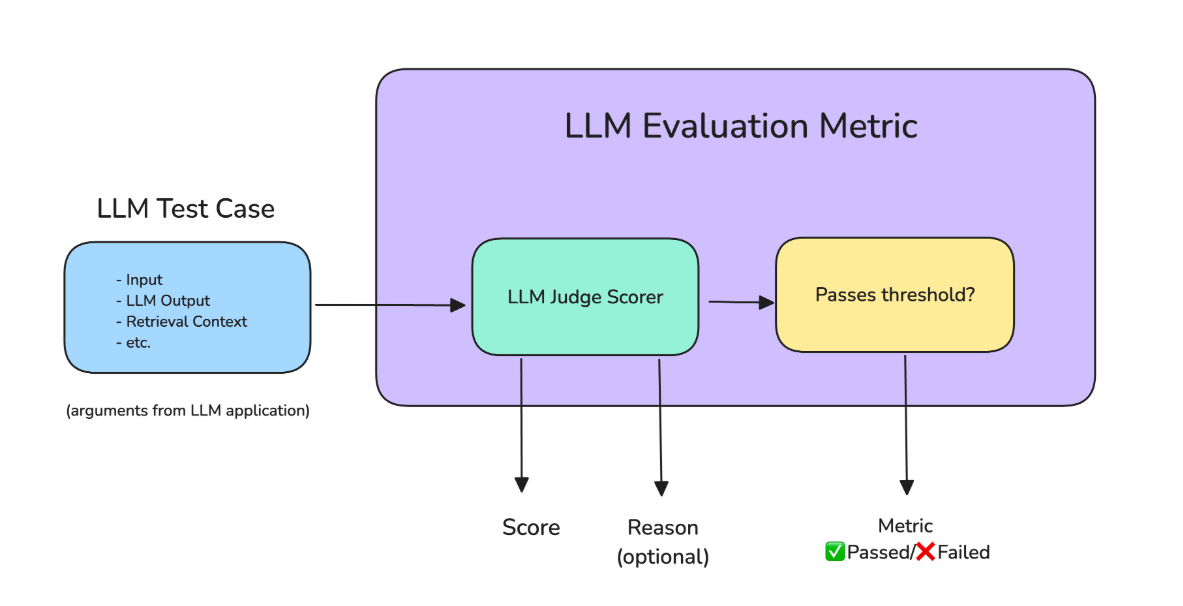
LLM-as-a-Judge is commonly used in three ways:
Single output scoring (without reference): Evaluate a response based on criteria such as relevance, clarity, or coherence.
Single output scoring (with reference): Compare a response against a ground-truth answer and assess its accuracy.
Pairwise comparison: Compare two responses and determine which better satisfies the evaluation criteria.
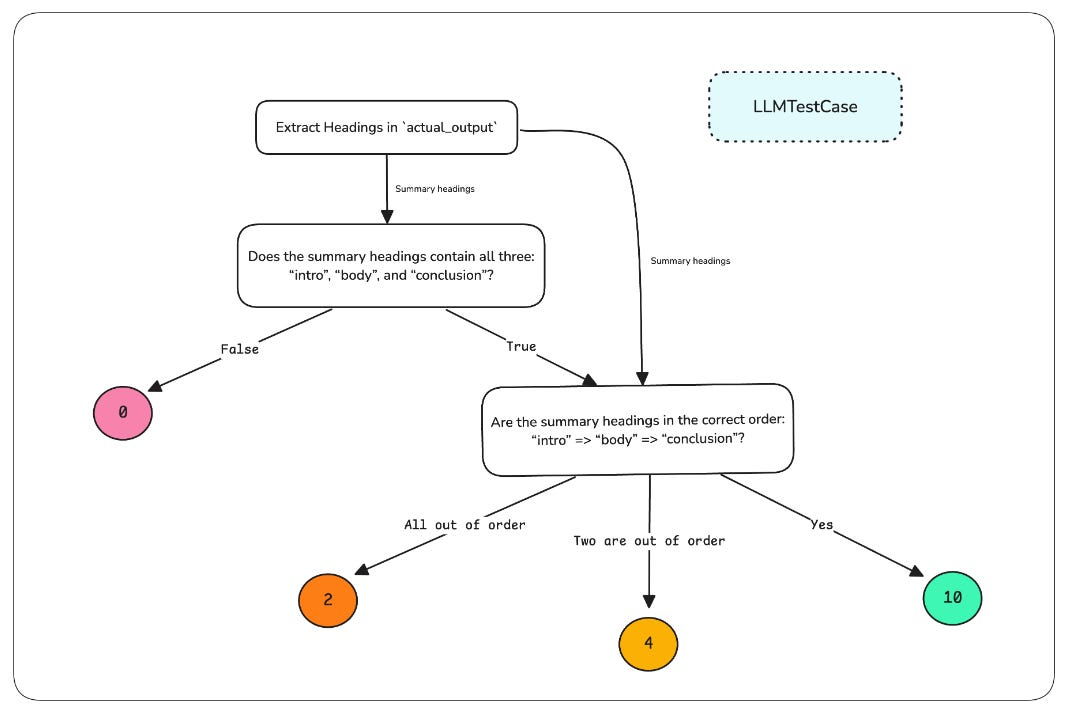
Frameworks such as DeepEval extend this approach using a Directed Acyclic Graph (DAG) structure, breaking evaluations into smaller decision steps (e.g., relevance, correctness, instruction following) before producing a final score.
Beyond LLMs
LLM-as-a-Judge can evaluate entire AI systems, not just standalone language models.
For example, it can assess whether a Retrieval-Augmented Generation (RAG) application correctly uses retrieved documents, whether an AI agent successfully completes a multi-step task, or whether a customer support chatbot provides accurate and helpful responses.
It can also be used alongside traditional machine learning systems.
For instance, an LLM judge can evaluate recommendation systems by assessing the relevance of recommended items, summarize and score outputs from document classification pipelines, or review insights generated by forecasting and analytics models for correctness and usefulness.
By judging outputs against criteria such as accuracy, relevance, completeness, and task success, LLM-as-a-Judge provides a flexible evaluation layer across a wide range of AI and ML applications.