
Inside Mixture of Experts
The key ideas behind sparse routing, specialized experts, and scalable intelligence

Introduction
Over the last few years, one trend has consistently driven progress in AI: scaling models has often led to better performance. Larger models, more parameters, and increased compute have enabled major improvements in reasoning, coding, and language understanding
But this approach comes at a massive cost. Training and serving frontier models now requires enormous infrastructure, energy, and compute budgets, making dense scaling increasingly difficult to sustain.
Mixture of Experts changes that equation.
Instead of activating an entire neural network for every token, MoE models activate only a small set of specialized “experts” depending on the task. Think of it less like consulting one giant brain and more like calling in the right specialists for the job.
This idea is now powering some of the most important open-source models today. For example, Mixtral 8x7B contains roughly 47 billion total parameters, but only about 13 billion are active for each token. In practice, that means the model gets the benefits of a much larger system without paying the full computational cost every time.
What makes this especially exciting is that MoE is no longer limited to language models. Researchers are now applying the same concept to image generation, object detection, autonomous driving, robotics, multimodal AI systems.
What is a Mixture of Experts?
At a high level, a Mixture of Experts model has two core components:
Experts — smaller specialized neural networks
A gating function (router) — decides which experts should process each token
Instead of sending every token through the entire model, the router dynamically selects only the most relevant experts.
Modern systems typically use Top-K routing. The gating function assigns scores to all experts and activates only the top few with the highest scores. For example, in a Top-2 system, each token is processed by only two experts while the rest stay inactive.
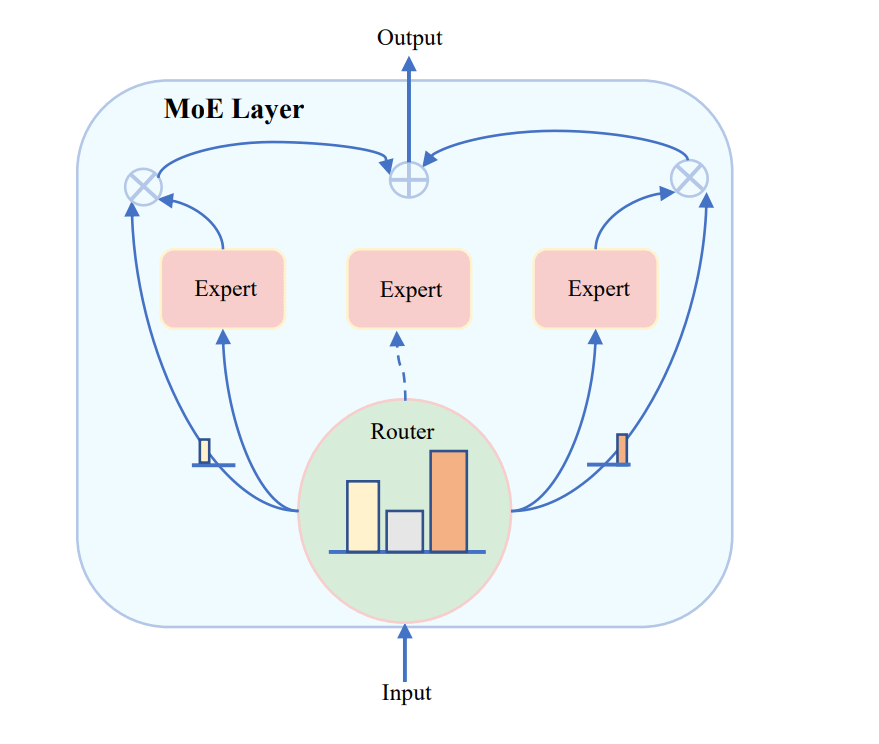
In transformer architectures, MoE layers are usually inserted into feed-forward blocks while attention layers remain dense. This creates a hybrid architecture that combines massive capacity with manageable compute costs.
During training, both the experts and the gating function are optimized together through backpropagation. Over time, the router learns which experts are most useful for different types of inputs, while the experts themselves gradually specialize in particular patterns, domains, or reasoning tasks.
Making MoE Training Efficient
While reading through a recent survey on Mixture of Experts architectures and training strategies, I came across several clever techniques that make large-scale MoE systems practical to train and deploy. Three approaches in particular stood out because of how important they’ve become for scaling modern MoE models efficiently:
Load Balancing Loss
One major problem is that routers may overuse a small number of experts while ignoring the rest. Load balancing losses help distribute tokens more evenly across experts so they all learn useful specializations.
Top-P Routing
Instead of always activating a fixed number of experts, newer systems sometimes use probability-based routing where the number of active experts changes dynamically depending on token complexity. Easier tasks may require fewer experts while harder reasoning tasks activate more.
On-Demand Expert Loading
Large MoE systems often suffer from expensive GPU-to-GPU communication. Modern architectures reduce this overhead by loading experts only when needed and minimizing unnecessary all-to-all communication between devices.
Applications of Mixture of Experts
Large Language Models
MoE has become one of the defining architectures behind modern frontier LLMs. Models like Mixtral 8x7B, DeepSeek-V3, Google’s Switch Transformer, all use sparse expert routing to dramatically increase parameter counts without proportionally increasing inference cost.
Switch Transformer was one of the first demonstrations that sparse architectures could scale toward trillion-parameter systems efficiently, while Mixtral showed that MoE could deliver strong open-source performance at practical serving costs.
This specialization also improves reasoning quality since different experts naturally learn different domains such as coding, multilingual reasoning, or mathematics.
Computer Vision and Autonomous Systems
MoE architectures are also being applied to computer vision and robotics. In autonomous driving systems, different experts can specialize in tasks like pedestrian detection, lane tracking, nighttime driving, or weather adaptation.
Google Research’s Vision Mixture of Experts (V-MoE) showed that sparse expert routing in Vision Transformers could match state-of-the-art vision performance while using significantly less inference compute.
Future Directions
Most ongoing MoE research is centered around two major challenges:
Improving Training Efficiency
As MoE models scale, communication between GPUs becomes a major bottleneck. Researchers are actively exploring ways to reduce routing overhead, improve load balancing, and make sparse computation more efficient on modern hardware.
Better Architecture Design
Another open question is how MoE systems should be structured in the first place, including how many experts a model should have and how those experts should specialize. Future work may involve using techniques like meta-learning or reinforcement learning to dynamically determine expert allocation and routing strategies instead of relying on manually designed configurations.